Separate informed arrivals from common liquidity shocks in the Duarte–Young model, and interpret AdjPIN through a checked expected-trade ledger.
Adjusted probability of informed trading
Adjusted probability of informed trading (AdjPIN) is the model-implied fraction of expected trades attributable to informed arrivals after allowing common liquidity shocks to raise both buying and selling. It helps a quant distinguish information-related activity from bursts of two-sided trading when interpreting order flow.
Duarte and Young extend the original probability of informed trading model with a shared shock to buy and sell arrival rates. “Symmetric” means that both sides respond; their increments need not be equal. Their construction uses mixtures of Poisson counts. Author manuscript, §3.2
What enters the denominator
Write the unrestricted model's expected daily components as
Here α is the probability of a private-information day; d is the conditional probability of positive information. The rates μb,μs describe informed buying on positive-information days and informed selling on negative-information days. The ε rates describe baseline uninformed trading. A shock adds Δb,Δs to the respective sides, with probability θ without private information and θ′ with it. All rates use the same daily horizon. This notation restates the manuscript's equation (7). Duarte–Young, p. 15
Thus θ=θ′ is a restriction: the full model permits dependence between the information state and shock occurrence.
A fictional 300-trade expectation
Suppose a hypothetical stock has a private-information event with probability 0.2 each day. Conditional informed arrivals average 100 on either news branch, so expected informed arrivals are I=0.2(100)=20 per day. Take baseline uninformed rates of 90 buys and 90 sells per day, giving U=180.
For this example only, impose θ=θ′=0.5: the shock indicator is independent of the information state. A shock adds 100 expected buys and 100 expected sells on a shock day. Therefore
The three components are expectations over repeated days. They do not describe 20 identified informed trades within an observed set of 300 executions. Nor is 6.67% a posterior classification probability for a particular observed trade.
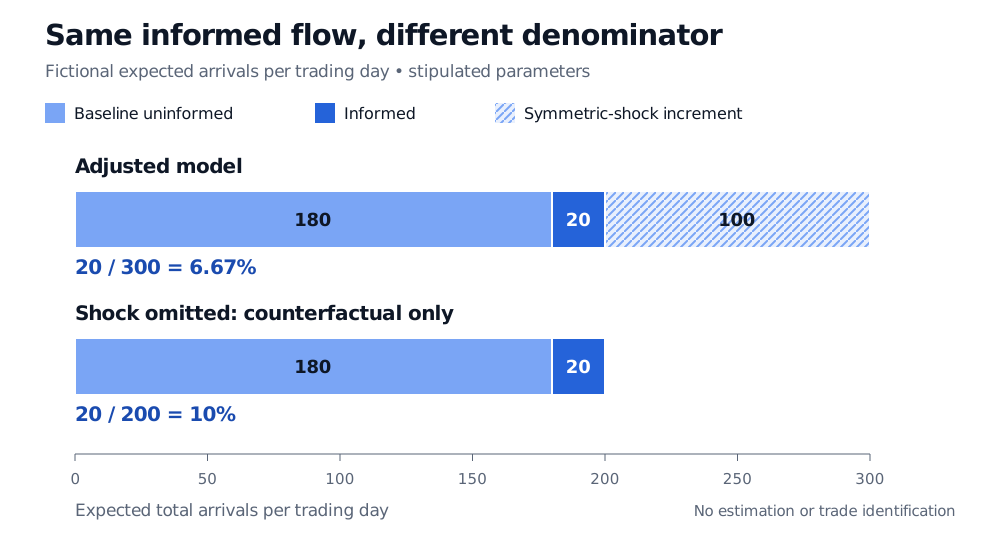
Fictional expected arrivals per day: 180 baseline uninformed, 20 informed and 100 symmetric-shock arrivals. Total 300 gives AdjPIN 6.67%. Omitting the shock gives a counterfactual total of 200 and ratio 10%, without refitting.
Original expected-arrival ledger under stipulated parameters. Bar length measures expected trade counts per day; the second row removes a component while holding the other parameters fixed.
If we omit the shock component while holding everything else fixed, the arithmetic becomes 20/(20+180)=10%. That is a counterfactual component ratio, not an estimate from fitting the original PIN model to these data. Refitting a different model can change every estimated component. The figure isolates a denominator effect; it does not demonstrate how much adjustment an empirical estimate will receive.
Reading an estimate responsibly
A practical research record should identify the trading-day window, trade-sign classifier and parameter restrictions. Ask whether apparent information-related activity survives reasonable changes to those choices. A number labelled AdjPIN without its model restrictions hides whether the two shock probabilities or the buy/sell rates were constrained to agree.
“Informed” names a latent economic component. The statistic does not identify traders or establish illegal conduct. It also supplies no return forecast by itself: the original paper's asset-pricing investigation is a separate empirical exercise, reported in the 2009 publisher abstract.
For the observable side of this distinction, Order Flow and Adverse Selection develops trade-sign estimation and the limits of interpreting persistent buying. The preview is public; the full lesson requires membership.
Sources
Duarte, J. and Young, L. Why is PIN priced? Author manuscript dated August 31, 2007, §3.2, especially equation (7), p. 15; §3.2.1 and Figure 4 describe the state mixture.
Duarte, J. and Young, L. (2009). Why is PIN priced? Journal of Financial Economics, 91(2), 119–138. Publisher abstract and bibliographic record; DOI: 10.1016/j.jfineco.2007.10.008.