A tax-free reorganization is a corporate restructuring that qualifies under U.S. federal income tax law for nonrecognition of gain or loss on specified steps. A Reverse Morris Trust pairs a spin-off or split-off with a merger of the separated business and another company. The distributing parent’s pre-deal shareholders typically receive a majority stake in the combined company. For a deal analyst, the intended tax treatment matters because it can affect both the cash the parent keeps and the conditions that must be met before the deal closes. 26 U.S.C. §§ 355, 368 · Discovery proxy statement and prospectus
The distribution and the merger
The parent distributes shares of a controlled subsidiary, usually called SpinCo. In a spin-off shareholders get them pro rata. In a split-off participating shareholders exchange parent shares for SpinCo shares. SpinCo then combines with the merger partner, and SpinCo holders receive shares in the combined company. If the parent transfers assets to SpinCo as part of the separation, that transfer and the distribution can qualify together under § 368(a)(1)(D) and § 355. The merger has its own requirements under § 368. 26 U.S.C. §§ 355(a), 368(a)
Among the distribution requirements are control of SpinCo just before the distribution as defined in § 368(c), qualifying active businesses with a generally five-year operating history, and a corporate business purpose independent of federal tax savings. The distribution must also avoid serving primarily as a way to distribute accumulated earnings and profits. 26 U.S.C. §§ 355(a)–(b), 368(c) · 26 C.F.R. § 1.355-2(b), (d)
What a 60/40 split tells you
Section 355(e) can trigger corporate gain when one or more persons directly or indirectly acquire at least 50% of voting power or 50% of stock value in the distributing or controlled corporation as part of the same plan or series of related transactions. The rules can reach predecessors and successors. A threshold-sized acquisition within the four-year window that starts two years before the distribution is presumed to be part of the plan unless the facts establish otherwise. The rule includes exactly 50%. 26 U.S.C. § 355(d)(4), (e) · 26 C.F.R. § 1.355-7
In a fictional merger, the parent’s pre-deal shareholders hold 60% of the combined company and other holders own 40%. If that 40% represents the entire acquisition counted under the plan and is 40% on both the voting-power and value measures, that acquisition falls below the threshold. The headline split alone leaves open the share classes, other related acquisitions, and the facts needed to qualify the distribution and the merger.
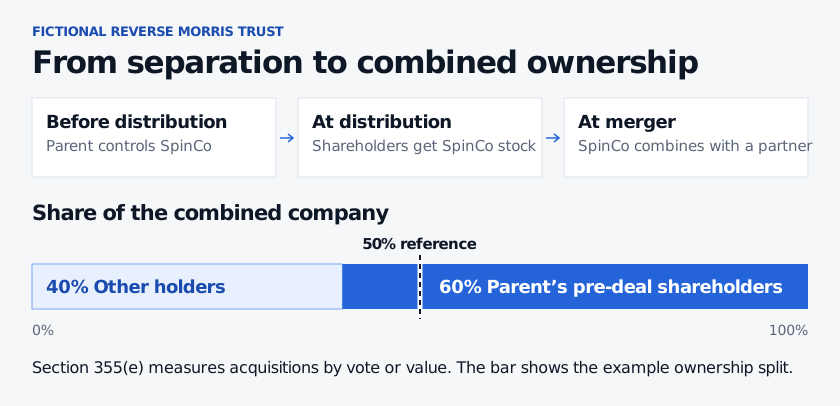
The same transaction has two steps and two ownership questions. The parent controls SpinCo before distribution. The example bar shows who holds the combined company after the merger.
Who recognises gain, and when
Section 355(e) can make the parent recognise corporate gain on the distribution of appreciated SpinCo stock while the shareholders’ receipt still qualifies for nonrecognition under § 355(a). Shareholder treatment of the merger exchange is a separate question under § 354, and cash or other property can lead to current gain under § 356. 26 U.S.C. §§ 355, 361, 354, 356
In a qualifying pro rata spin-off, the shareholder generally allocates their existing tax basis between the retained parent shares and the SpinCo shares. In a qualifying stock-only merger exchange, the SpinCo basis generally carries over into the combined-company shares. That basis enters the gain calculation on a later sale, so the transaction can defer tax on built-in gain. 26 U.S.C. § 358(a)–(c)
The WarnerMedia filing
Discovery’s 10 February 2022 proxy statement and prospectus projected that AT&T holders receiving SpinCo shares would own about 71% of Warner Bros. Discovery common stock on a fully diluted basis, excluding overlap with Discovery’s pre-merger holders. The filing separately described tax opinions on the distribution and merger as closing conditions and identified a narrower IRS ruling covering the distribution and certain related steps. The opinions relied on representations and assumptions about how the deal would be completed. If those facts changed materially, the conclusions could change, and the IRS could disagree with counsel. Discovery proxy statement and prospectus, The Transactions and Material U.S. Federal Income Tax Consequences
For the return-series effect of a spin-off, the SelfMadeQuant lesson on equities, indices and corporate actions explains how data vendors account for the value of the shares delivered. The full lesson requires membership.
Sources
- U.S. Internal Revenue Code, § 355, distributions of controlled corporations and § 368, definitions relating to corporate reorganizations.
- U.S. Internal Revenue Code, § 354, shareholder exchanges, § 356, additional consideration, § 358, basis to distributees and § 361, corporate nonrecognition.
- U.S. Treasury regulations, 26 C.F.R. § 1.355-2 and § 1.355-7.
- Discovery, WarnerMedia transaction proxy statement and prospectus, 10 February 2022.