SPAN margin is a portfolio margin requirement calculated using Standard Portfolio Analysis of Risk, a methodology developed by CME. Its classic calculation tests contract values under specified market scenarios, recognizes eligible offsets, and applies additional charges and floors. For a derivatives desk, the practical consequence is that two positions' combined requirement can differ substantially from the sum of their standalone requirements. SPAN is a particular method of portfolio margin, not a synonym for every portfolio margin model. CME's methodology overview describes the framework.
Read across a scenario, then find the loss
A risk array records a contract's modeled value changes under a set of shocks. Classic SPAN commonly uses 16 scenarios combining underlying-price moves and volatility moves, with the passage of time also reflected in option valuation. The scenario count and shock parameters belong to the exchange or clearing organization. A risk array is not a sample of 16 equally probable future outcomes. CME's 2019 SPAN presentation, slides 3–8, explains this classic structure; its historical contract examples are not current margin rates.
The key operation is to add compatible positions within each scenario first. Consider two fictional positions already sized and expressed in USD, in the same eligible risk grouping. These four stipulated scenarios are a reduced teaching grid, not the full SPAN grid or market data.
| Modeled P&L, USD | Scenario 1 | Scenario 2 | Scenario 3 | Scenario 4 |
|---|---|---|---|---|
| Position A | −1,200 | −800 | +300 | +600 |
| Position B | +500 | +200 | −100 | −400 |
| Portfolio A + B | −700 | −600 | +200 | +200 |
Here a negative number means a loss. If denotes position 's P&L in scenario , the reduced scanning calculation is
The largest portfolio loss is USD 700, in scenario 1. A's standalone worst loss is USD 1,200 in scenario 1; B's is USD 400 in scenario 4. Adding those two standalone worst losses gives USD 1,600, but combines losses from different states. That sum misses the offset visible when both positions face the same scenario.
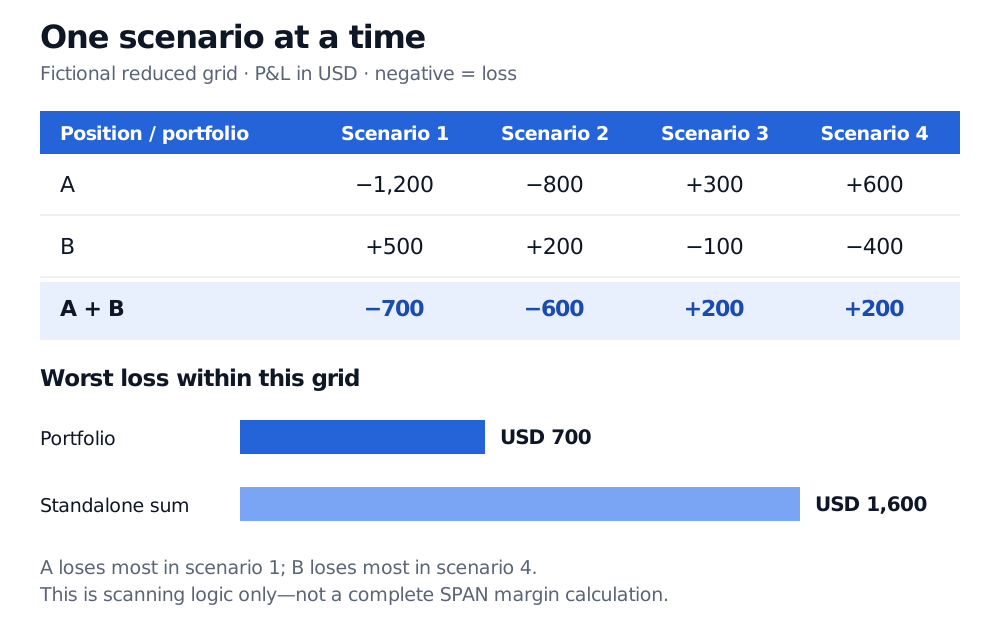
Figure: Add P&L within each common scenario before selecting the worst loss. The USD 700 result is reduced scanning risk, not a complete margin requirement.
Sign conventions matter when reproducing a report. A loss-cost array can express losses as positive values, whereas the table above uses negative P&L for losses. Confirm the file or report's convention before taking a maximum; otherwise the calculation can select the largest gain.
Why scanning risk is only part of the requirement
Classic SPAN first groups eligible contracts into combined commodities, generally based on a common underlying. It then applies prescribed rules for offsets between groups. Arbitrarily adding every instrument into one global grid would grant offsets that the methodology may not allow. CME's overview of combined-commodity evaluations identifies the other components:
- Intra-commodity spread charges recognize residual risk across contract maturities. A calendar spread can have little outright-price exposure while the difference between its two delivery prices still moves.
- Inter-commodity spread credits recognize permitted offsets between related products. Economic intuition alone does not establish eligibility or the credit rate.
- Delivery risk charges address additional exposure as physically deliverable contracts approach delivery.
- Short option minimums impose a floor when the scenario grid understates the danger of short options far from the money. Small present sensitivity does not rule out a large loss after an extreme move.
The short-option floor is explained in CME's Margins on Options. Option-value treatment also matters: a scan result alone does not tell you the cash needed after accounting for option premiums and values. Consequently, USD 700 is neither an actual exchange margin quote nor an instruction to fund this fictional portfolio with USD 700.
Classic SPAN and SPAN 2 coexist
For CME Group, checked on 30 October 2026, the public SPAN 2 rollout page states that Energy and Equity contracts have migrated to SPAN 2. It lists Interest Rates and FX under its 2026 timeline and Agriculture and Commodities as upcoming. A timeline entry does not establish that every contract in that asset class has completed migration. CME directs users to the daily MARGIN002 report for the dynamic list of live contracts; that report requires special entitlements.
SPAN 2 should not be reproduced as the classic 16-scenario maximum. CME's methodology description combines historical and stress risk with liquidity and concentration charges. It also models options risk with volatility-surface information. The model in force, product scope, parameter date and eligible offsets therefore matter when reconciling a production margin calculation.
The margin buffer and the settlement payment
SPAN concerns a requirement for potential future exposure. Initial margin supports that buffer; variation margin settles changes in position value. A favorable offset in the scan does not remove a cash settlement obligation on a losing position. CME distinguishes these functions in Clearing House Risk Management. Neither the scan's worst scenario nor the posted margin caps losses outside the modeled conditions.
For a worked account example separating the buffer from realized settlement losses, see Margin and Collateral (public preview; full lesson requires membership).
Sources
- CME Group, SPAN Methodology Overview, risk arrays, parameters and combined-commodity evaluations.
- CME Group, CME SPAN: Standard Portfolio Analysis of Risk, 2019 presentation, slides 3–8 and 14–16; historical explanation of classic SPAN.
- CME Group, Margins on Options, option-value treatment and short option minimums.
- CME Group, SPAN 2 Framework Rollout, timeline and contract-scope reporting, checked 30 October 2026.
- CME Group, SPAN 2 Methodology and Functionality, market, stress, liquidity and concentration components.
- CME Group, Clearing House Risk Management, performance bonds and settlement variation.