A securitisation trustee is a party appointed under the documents of a securitisation to hold or exercise specified rights or perform specified duties for the deal. An indenture trustee acts under the note indenture for noteholders. Its duties can include holding a security interest, transferring cash between deal accounts, providing reports and exercising remedies. For a cash-flow model, the distinction matters because the party that calculates a payment can differ from the party that moves the money.
Who calculates, who pays, who holds the rights?
In Honda Auto Receivables 2025-3, American Honda Finance Corporation supplied the receivables as sponsor, selling them to a depositor, which conveyed them to the issuer, a statutory trust that issued the asset-backed notes. The issuer pledged the receivables and other collateral to Citibank as indenture trustee to secure the notes. The Bank of New York Mellon was the owner trustee. It signed the indenture for the issuing trust and had duties to administer the issuer in the interests of certificateholders under the trust agreement. Receivables Purchase Agreement §2.01, Sale and Servicing Agreement §2.01, Indenture granting clause and signatures, Trust Agreement §§6.01–6.02.
American Honda Finance Corporation also acted as servicer and administrator. In its servicing role it collected borrower payments, prepared the Servicer’s Certificate and calculated amounts for the note and certificate distribution accounts. The certificate supplied information for the payment instructions sent to Citibank. In its administrative role it prepared or arranged filings and other documents for the issuer or owner trustee. Citibank also had separate paying-agent and calculation-agent roles. Its calculation role included obtaining the floating-rate benchmark for one class of notes. Sale and Servicing Agreement §§3.01, 3.10 and 4.06, Prospectus, Administration Agreement, Indenture §§2.07(d)–(e), 3.03 and 6.14.
Follow the cash on one payment date
Suppose the collection account has USD 12 available. This fictional deal’s cash-flow waterfall pays a USD 1 trustee fee first, then a USD 7 senior claim, then sends any remaining cash to the residual holder. With no other claims or reserves in this example, the residual holder receives USD 4. The instructions and cash ledger reconcile when each payment reduces the available balance and nothing remains after the residual is paid.
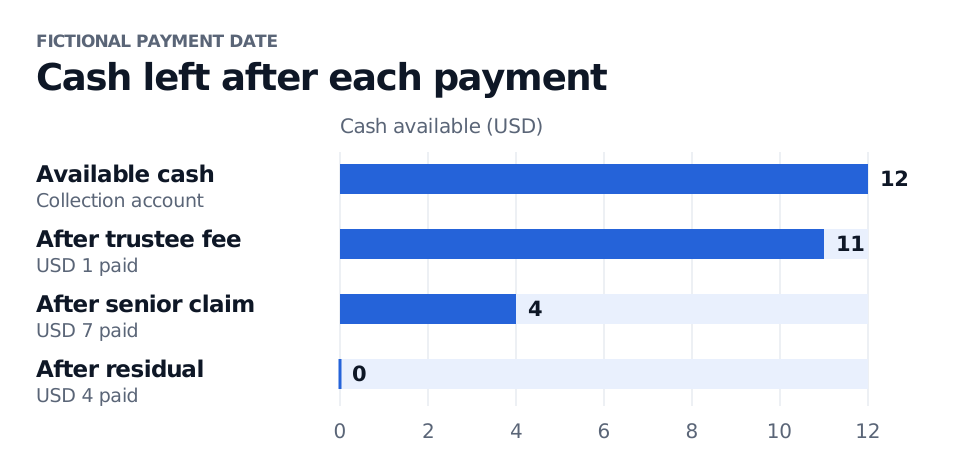
The bars track cash remaining after each instruction. The payment amounts are the drops between successive bars.
Honda’s ordinary waterfall pays outstanding servicing advances and servicing fees before eligible unpaid trust fees and expenses. The earlier trust-fee allocation is capped under specified conditions, and any unpaid remainder ranks farther down, after note distributions and the reserve top-up. In a model, the fee amount and its priority belong in separate inputs because one expense can have more than one place in the waterfall. Sale and Servicing Agreement §4.06(c)(i)–(iii) and (ix)–(x).
The SelfMadeQuant lesson Non-Agency MBS, ABS, and the Securitization Waterfall covers how payment priority and loss allocation work across tranches. The lesson has a public preview and requires membership for full access.
What changes after default?
Under Honda’s indenture, outside a continuing Event of Default actually known to a responsible officer, the indenture trustee’s duties are the ones specified in the indenture. It checks required certificates and opinions for conformity with the indenture and may rely on conforming documents in the absence of bad faith. Checking conformity and independently verifying the data are distinct tasks. The indenture expressly limits the trustee’s duty to verify the contents of servicer reports it believes are genuine and properly signed or presented. Indenture §6.01(a), (b) and (j).
If a responsible officer knows of a continuing Event of Default under the indenture, the trustee must exercise its indenture powers with prudent-person care. Remedies can include enforcement proceedings, subject to the indenture’s conditions. A borrower missing an auto-loan payment affects the receivables pool. The note indenture has its own definition of an Event of Default and separately specifies how recoveries collected under its remedies article are distributed. Indenture §§5.01–5.05 and 6.01(a).
Sources
- Honda Auto Receivables 2025-3 Owner Trust, Indenture, 12 August 2025
- Honda Auto Receivables 2025-3 Owner Trust, Sale and Servicing Agreement, 12 August 2025
- Honda Auto Receivables 2025-3 Owner Trust, Amended and Restated Trust Agreement, 12 August 2025
- Honda Auto Receivables 2025-3, Receivables Purchase Agreement, 12 August 2025
- Honda Auto Receivables 2025-3 Owner Trust, final prospectus