Owners’ equivalent rent (OER) is the estimated rent homeowners would pay to live in their own homes if they rented them unfurnished and without utilities. In the U.S. consumer price index, the OER index tracks changes in the price of that housing service. A home sale prices the property as an asset, and a mortgage payment reflects the terms of a loan. Those figures can move differently from the rental value of living in the home. BLS CPI Handbook of Methods
What sets the weight and what moves the index?
The Bureau of Labor Statistics (BLS) asks homeowners in the Consumer Expenditure Survey what they think their home would rent for. Those estimates help establish the expenditure weight of owner-occupied shelter in the CPI. They also inform the sampling and weighting of rental observations. The monthly price-change observations come from a separate survey. BLS rent and rental equivalence fact sheet
The CPI Housing Survey collects actual contract rents from sampled rental homes. For OER, BLS adjusts for changes in housing quality and removes the estimated value of utilities bundled into rent to derive pure rent. It weights these rental observations to represent owner-occupied housing, including differences in the mix of detached and other homes. The tenant rent index uses the same survey with renter weights and treats bundled utilities as part of the service included in rent, adjusting for changes in what's provided. BLS also estimates missing observations. For a sampled unit reported vacant, it uses rent changes from newly occupied units to estimate the unit's rent. BLS rent and rental equivalence fact sheet
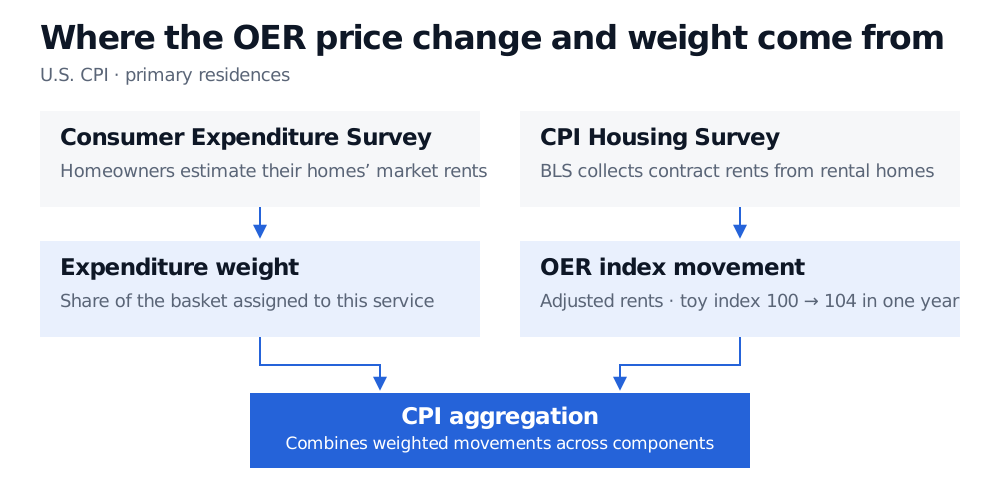
The diagram separates the price observations from the expenditure weight used in aggregation. The index levels are fictional.
Reading a 4% OER print
Suppose a fictional OER index goes from 100 to 104 over exactly 12 months. Its year-over-year change is
The estimated price of owner-occupied shelter services rose 4%. To see how that feeds into headline inflation, imagine a fixed-weight basket in which OER starts at a 20% share. The 4% component increase contributes percentage points to the basket’s inflation. The other components determine the rest. For a published CPI, use the relevant period and aggregation weights. BLS CPI Handbook of Methods
Why new-lease rents can turn first
A new-lease series reflects current terms for people moving into rental homes. The CPI rent sample also includes continuing tenants whose rents may stay fixed until renewal. BLS reprices each sampled unit every six months on a staggered schedule and updates the index monthly. The mix of continuing and new tenants, together with that collection schedule, can make CPI shelter respond more gradually than new-lease rents. The timing depends on which rents reset and when. For a release or a forecast, treat new-lease rents as a separate series with different coverage. BLS explainer on changes in shelter prices