An OPEC+ quota is an agreed target for a participating country's crude oil production over a specified period. OPEC+ coordinates production among OPEC members and other oil producers. Spare capacity is the additional production rate that can be brought online and sustained under a stated methodology. The quota helps an oil analyst estimate what producers intend to supply. Spare capacity helps estimate how much extra supply could respond to a disruption. OPEC's November 2026 decision, EIA's capacity methodology
Read the target, the output and the capacity separately
Target. Use the production schedule that applies to the country and month, including any applicable voluntary adjustments. On 1 November 2026, seven OPEC+ participants said they would carry their September required production levels into December. In their August release, the same participants announced an adjustment to their voluntary cuts for September and separately reiterated their commitment to compensate for earlier overproduction. A compensation plan schedules reductions to make up for past excess output. Check whether the schedule already incorporates those reductions before adjusting a target. OPEC's August 2026 decision, OPEC's November 2026 decision
Actual output. Use a separate estimate of the crude oil produced during that period. Match the country or group, reporting period and crude definition before subtracting. For example, EIA's Short-Term Energy Outlook (STEO) Table 3d reports both an OPEC+ production total and an OPEC production total. Its reported OPEC surplus capacity has a different country scope from the OPEC+ output total. EIA's STEO Table 3d
Effective capacity. Under EIA's December 2025 STEO methodology update, effective capacity is the crude production rate producers could reach within 90 days and sustain without damaging fields or operations. EIA deducts unplanned disruptions from maximum sustainable capacity to estimate effective capacity. For the producers covered by its surplus measure, EIA subtracts actual output from effective capacity. A voluntary production cut can leave capacity available to restart. An outage can take capacity out of service. EIA's capacity methodology
One producer, two gaps
Suppose a fictional participating country has a target of 5.0, actual production of 4.8 and qualifying effective capacity of 6.0, all in million barrels per day for the same crude scope and month.
The first gap measures how much production could rise before reaching the agreed target. The second measures how much it could rise before reaching effective capacity. If an outage takes 0.4 million barrels per day of idle capacity out of service, effective capacity falls to 5.6. With the target and output unchanged, target headroom stays at 0.2 while spare capacity falls to 0.8 million barrels per day.
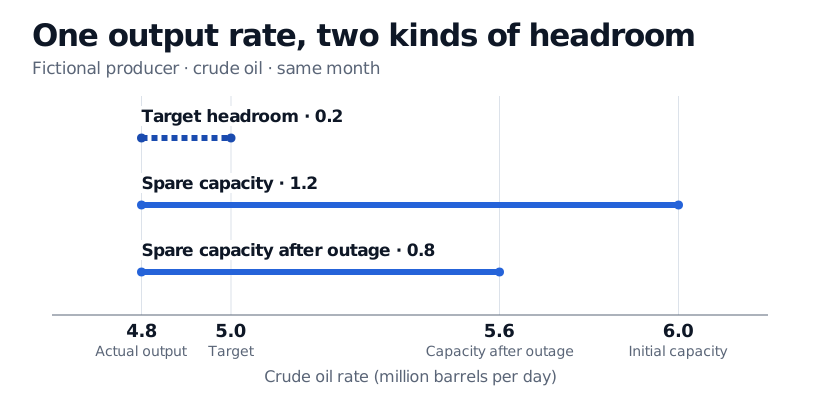
All three intervals start at actual output. The outage shortens the physical buffer even though the target and current production stay fixed.
Which barrels can reach the market?
For a supply disruption, compare the lost flow with extra production that countries are likely to authorize and can deliver in time. A producer may need weeks to ramp up, and transport constraints or differences in crude grade can limit substitution. Crude inventories can help cover the gap while production ramps. When spare capacity and inventories look thin relative to the possible loss, even an expected disruption can put upward pressure on spot prices. EIA's guide to crude oil spot prices
Sources
- OPEC — 2 August 2026 production decision and 1 November 2026 required-production decision.
- U.S. Energy Information Administration — December 2025 capacity methodology update and STEO Table 3d, World Crude Oil Production.
- U.S. Energy Information Administration — What drives crude oil prices: Spot Prices.