The Market Access Rule is US SEC Rule 15c3-5: it requires broker-dealers with market access to establish, document and maintain risk controls and supervisory procedures for that activity. Its practical consequence for a quant execution system is that a strategy's decision to trade must pass the broker's applicable controls before reaching the market. A profitable signal does not create permission to submit an order.
Whose access, whose responsibility?
The rule's definition covers securities trading access through membership of an exchange or subscription to an alternative trading system, and access an ATS's broker-dealer operator provides to a non-broker-dealer. It also addresses a broker providing access through its market participant identifier or otherwise. This is a specific US securities framework, not a universal rule for every electronic trading venue. See 17 CFR 240.15c3-5(a)–(b).
Sponsoring market access does not remove the broker. The SEC's adopting release distinguishes direct market access, where orders pass through the broker's trading system, from sponsored access, which can bypass that system. Bypassing the trading system does not permit bypassing the required controls. The release explains that unfiltered access is effectively prohibited. SEC adopting release, pp. 5–6.
More than a maximum order size
The required controls have two complementary purposes:
| Control family | What it addresses |
|---|---|
| Financial | Aggregate customer credit and broker capital thresholds; erroneous orders identified through price, size or duplication parameters |
| Regulatory | Requirements that must be satisfied before order entry; restricted securities; access by authorised persons and accounts; immediate execution reports to appropriate surveillance personnel |
A per-order size check cannot replace aggregate exposure control. Nor can a passing credit check establish that an order satisfies a trading restriction. Immediate post-trade reporting is another obligation; it does not replace prevention before entry. SEC adopting release, summary.
A fictional credit gate
Suppose a broker stipulates a USD100,000 aggregate open-buy-notional limit for one customer. At this instant, existing open buy orders reserve USD60,000 and a new buy would add USD50,000. Assume fixed USD notionals, no offsets and no other exposure consuming this toy limit.
The gate rejects the new order before routing. Available headroom is USD40,000; the proposed order exceeds it by USD10,000. Each order amount fits below USD100,000 when viewed separately, which is precisely why separate order checks miss the breach.
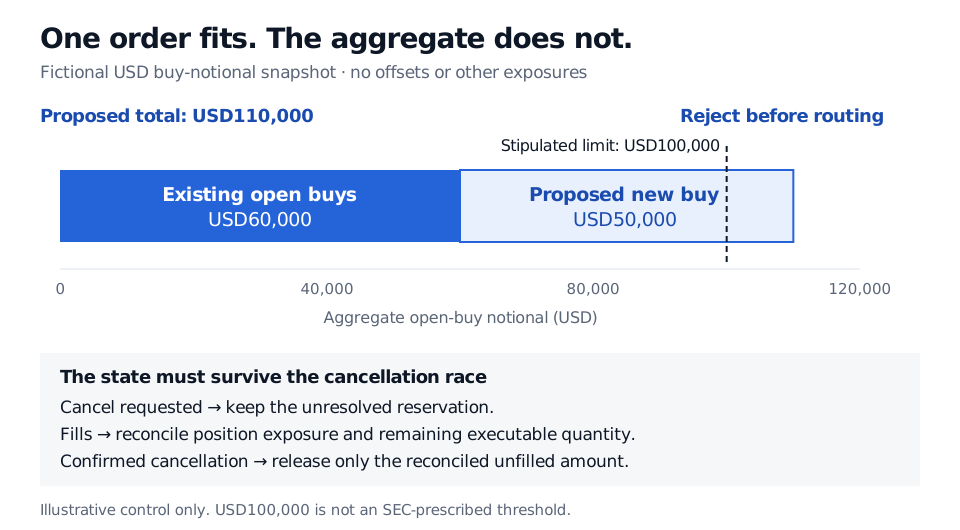
Figure: A fictional aggregate check rejects USD110,000 against a stipulated USD100,000 limit. The threshold and open-buy-only exposure measure are teaching assumptions, not SEC prescriptions.
This illustrates one pre-trade risk check. The SEC does not prescribe this USD100,000 threshold. Staff FAQ 8 explains that threshold selection requires justified business judgment and ongoing monitoring; FAQ 16 rejects a send-first, cancel-immediately approach to preventing entry. SEC staff FAQs 8 and 16.
The arithmetic needs a defined risk aggregation: which customer, accounts, venues, instruments, currencies, filled positions and outstanding instructions consume which risk limit. An exposure reservation records capacity committed to an order that might still execute. Concurrent submissions must check and reserve against consistent state; two gateways cannot independently spend the same remaining capacity. Staff FAQ 5 specifically discusses coordinating separate venue controls. SEC staff FAQ 5.
A cancellation request alone does not prove that the order has stopped being executable. Retain its unresolved reservation, reconcile racing fills, and release only the confirmed unfilled amount. A fill can move exposure from an open order into a position; it does not automatically restore total credit capacity. Opposing orders also need explicit treatment: an unfilled sale cannot simply be assumed to offset a buy that fills first.
Live Execution Monitoring develops these reservation and reconciliation mechanics, with a public preview and membership required for the full lesson. The toy gate above omits position valuation, derivatives exposure, collateral and other required controls; it cannot establish a firm's compliance.
Control cannot simply be handed to the customer
Paragraph (d) places the required controls under the broker's direct and exclusive control. Its limited allocation exception concerns specific regulatory controls, not financial controls: written contract, thorough due diligence, a registered broker-dealer customer, and a reasonable basis that its ultimate-customer relationship and information make it better able to implement those controls. Allocation leaves the providing broker responsible. Rule 15c3-5(d).
Staff FAQ 9 further says that allocation is unavailable when that customer trades for its own account. Independent third-party technology can be used, but the broker must retain the required control and perform due diligence; buying software is not a transfer of responsibility. SEC staff FAQs 5, 9 and 17.
The continuing review obligation
Paragraph (e) requires regular effectiveness reviews and prompt attention to issues. At least annually, the broker reviews its market-access business activity under written procedures and documents the review. The CEO or equivalent officer annually certifies that the controls and procedures comply with paragraphs (b) and (c), and that the review occurred. The certification is not a statement that every trade will be error-free. Rule 15c3-5(e).
Sources
US rule text checked on 31 October 2026; the eCFR displayed Title 17 as current through 28 October 2026. The 2010 release explains adoption; the staff FAQs express staff views rather than Commission rules.
- eCFR — 17 CFR 240.15c3-5, current displayed text, especially paragraphs (a)–(e).
- GovInfo — 17 CFR 240.15c3-5, 1 April 2025 edition, official annual-edition text; checked against the current eCFR provision.
- SEC — Release No. 34-63241, 3 November 2010, summary and discussion of direct, sponsored and unfiltered access.
- SEC Division of Trading and Markets — Market Access Rule FAQs, dated 15 April 2014, with an internal last-reviewed date of 6 June 2014; especially questions 5, 8, 9, 16 and 17.