Housing starts, permits and home sales data measure different events in the housing market. Permits measure how many new units local authorities approved, starts measure how many began construction, and sales measure transactions at a defined stage. Completions show how many units finished construction. For a quant tracking the business cycle, the distinction helps separate planned building, work underway, new supply and buyer activity. U.S. Census Bureau New Residential Construction
What each release counts
| Series | What goes into the reference month |
|---|---|
| Building permits | New privately owned housing units authorised in places that issue permits. The headline counts units authorised, so one apartment building permit can account for many units. |
| Housing starts | New privately owned units whose construction began. Census generally dates the start to excavation for the foundation or footings and counts every unit in an apartment building at that point. The national starts estimate also includes areas where permits are unnecessary. |
| Housing completions | Units that reach the survey's completion threshold. For a single-family house this is generally finished flooring or earlier occupancy. Multifamily buildings have a separate occupancy or availability threshold. |
| New-home sales | New single-family houses for which a buyer signed a sales contract or a builder accepted a deposit. The sale is intended to include both house and land. The series excludes multifamily sales and houses built for rent or built on the owner's land. It counts the initial sale even if the transaction later falls through. |
| Existing-home sales | NAR estimates closings from a sample of multiple listing services. Its headline covers existing single-family homes, townhomes, condos and co-ops. |
Construction coverage is wider than new-home sales by structure type. It still excludes publicly owned housing and HUD-code manufactured homes. The construction series come from the Building Permits Survey and the Survey of Construction, which HUD helps fund. Census construction definitions · Survey of Construction methodology · NAR Existing-Home Sales release notes
The sale can come first
A builder can sell a new house from plans before a permit is issued or excavation begins. The same house can therefore appear in the sales series in one month, permits in another, and starts and completions later. An existing home under contract in September and closed in October counts in October's existing-home sales. The two sales series can move in opposite directions because they cover different homes and date sales at different events. Census Survey of Construction definitions · NAR Existing-Home Sales release notes
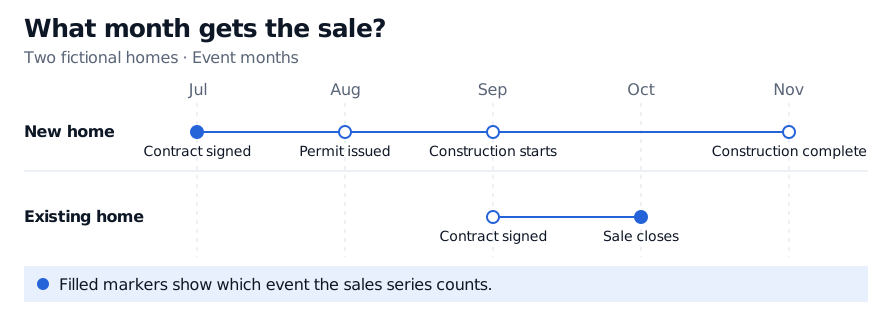
The filled markers show the events counted in the two sales series. The months describe when the events occur.
Permits show a potential pipeline. Starts can draw from permits issued in earlier months, and some authorisations may stay unstarted. Completions can rise while starts fall as builders finish older projects. To estimate how quickly permits turn into starts, follow units by month of authorisation. Dividing this month's total starts by this month's permits mixes groups of homes and can also mix coverage. Census starts rates by authorisation month · Survey of Construction methodology
What 1,200 at an annual rate means
The Census headline commonly uses a seasonally adjusted annual rate (SAAR). Seasonal adjustment estimates and removes recurring seasonality, such as a typical winter slowdown. An unusually severe winter can still affect the adjusted series. Annualisation then expresses that one adjusted month's pace in yearly units. Census definition of SAAR
Suppose a fictional series has 100 starts in a month after seasonal adjustment. Its headline annual rate is
The 1,200 expresses how many starts there would be over a year at that month's pace. An actual annual total comes from the activity across the year, and a forecast would require assumptions about future months. If a table is in thousands of units at an annual rate, it would show for the same example. Census definition of SAAR
Put the data on the release clock
Keep the reference month of the activity separate from the release timestamp and the data vintage. The Census construction and new-home sales reports have separate release dates. A September starts estimate first published in October becomes usable when the release reaches the research system. Census revises preliminary estimates and can update earlier seasonally adjusted values when it recalculates seasonal factors. Census release schedule · Survey of Construction release and revision schedule
For a historical trading decision, use the latest version already available at that decision time. Putting a revised September value into a backtest row dated September gives the strategy information from the future. The SelfMadeQuant lesson Point-in-Time Data shows how to select eligible versions and audit revisions. The preview is public and the full lesson requires membership.
Sources
- U.S. Census Bureau Survey of Construction definitions
- U.S. Census Bureau New Residential Construction
- U.S. Census Bureau Survey of Construction methodology
- U.S. Census Bureau Survey of Construction release schedule
- U.S. Census Bureau starts rates by authorisation month
- NAR Existing-Home Sales release notes, 13 October 2026