FX reserve adequacy metrics compare an economy’s official reserve assets with potential foreign-currency funding needs. The denominator tells you what kind of shock the buffer is being tested against. A fall in export receipts can make it harder to pay for imports, while a loss of access to foreign lenders can make it harder to refinance maturing debt. IMF DataMapper, Assessing Reserve Adequacy.
One reserve stock, two denominators
Suppose a fictional economy reports USD 60 billion in gross official reserves. Imports of goods and services run at USD 12 billion per representative month, and USD 50 billion of external debt falls due within the next 12 months on a remaining-maturity basis.
The import ratio expresses reserves in months of spending at the assumed pace. A monthly average can be calculated as annual imports divided by 12, using a stated historical or forecast window. The debt ratio compares the stock with near-term debt facing rollover risk. Remaining maturity counts what comes due within the year, including payments on originally long-term debt. If USD 20 billion was originally short-term and another USD 30 billion of originally long-term debt is due within the year, both enter the denominator. IMF staff guidance, Annex I. External Debt Statistics Guide, Chapter 6.
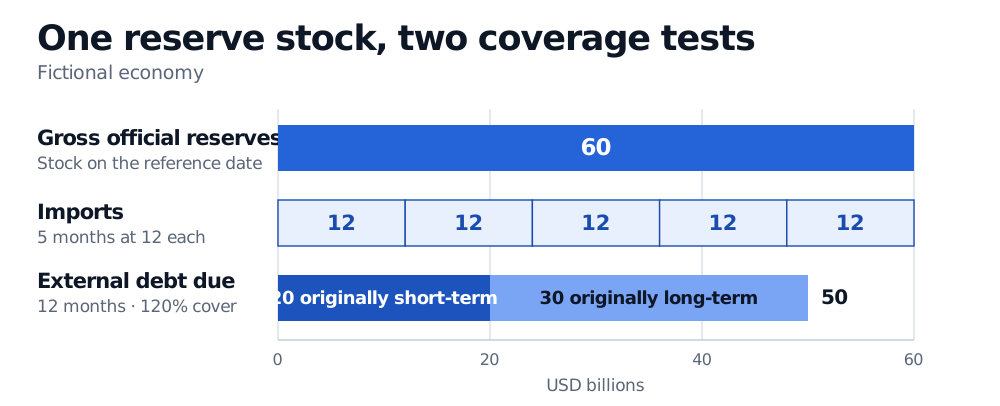
Each row uses the same USD scale. The import row repeats one month’s spending five times. The debt row groups the next 12 months of obligations by original maturity.
The two ratios test separate claims on the same pool of assets. If both shocks occur together, reserve use to meet one need leaves less for the other. Actual reserve use also depends on export receipts, other financing and changes in import spending. The debt denominator covers liabilities to nonresidents, including some that may be payable in local currency. For banks and firms with FX debts, access to official reserves depends on how the authorities can channel those funds. External Debt Statistics Guide, Chapter 2.
What can the authorities deliver on time?
Gross official reserves are a starting stock. Check the currency mix, which assets can be sold or converted into the required settlement currency by the payment date, and whether any reported assets are pledged or otherwise encumbered. Then map predetermined drains, such as scheduled central-government FX debt service and the foreign currency the authorities must deliver on maturing FX swaps. A swap can bring in dollars today while committing the authorities to deliver dollars later. Build a dated schedule of usable assets, inflows and outflows by currency, counting each contractual payment once. Keep contingent drains, such as guarantees that are called only under stress, in the relevant scenario. IMF reserve and foreign-currency liquidity template, sections II–IV.
Where the IMF’s ARA metric fits
Reserves divided by broad money is another standalone ratio. It gauges the reserve stock against a proxy for the scale of potential resident outflows. The IMF’s Assessing Reserve Adequacy metric for emerging markets uses a weighted denominator built from exports, broad money, short-term external debt and other external liabilities such as portfolio equity and medium- and long-term debt. These components proxy for lost export income, resident outflows, debt rollover pressure and other nonresident portfolio outflows, respectively. Baseline weights depend on the exchange-rate regime, and country assessments can adjust the baseline. The IMF publishes reserve coverage of this composite alongside import, debt and broad-money coverage. Which ratios matter most depends on the economy’s exposures and access to funding. IMF DataMapper, ARA dataset. IMF staff guidance, paragraph 19 and Annex I.
Sources
- IMF DataMapper — Assessing Reserve Adequacy dataset.
- IMF — Guidance Note on the Assessment of Reserve Adequacy and Related Considerations, paragraph 19 and Annex I.
- IMF — External Debt Statistics Guide, Chapter 6, “Remaining Maturity”.
- IMF — External Debt Statistics Guide, Chapter 2, definition of external debt.
- IMF — International Reserves and Foreign Currency Liquidity, data template sections II–IV.