Understand why separated logistic samples produce infinite ordinary coefficients, how the Firth information penalty gives finite estimates, and what bias reduction does not guarantee.
Firth correction and complete separation
Firth correction is a likelihood-based method that reduces the leading asymptotic bias of logistic-regression coefficient estimates. It also gives finite estimates when complete separation makes ordinary maximum likelihood diverge, provided the design matrix has full column rank. In a sparse credit dataset, a feature that perfectly divides repayments from non-repayments can otherwise produce an enormous fitted coefficient that reflects the sample's geometry rather than a reliably measured effect.
Why the ordinary fit runs away
In logistic regression, independent binary outcomes have model probabilities
pi=1+e−xi⊤β1.
The feature vector xi includes a constant if the model has an intercept. Complete separation means there is a direction in coefficient space giving a strictly positive score to every observed success and a strictly negative score to every observed failure. Increasing the magnitude along that direction keeps improving the ordinary likelihood: at least one coefficient has no finite maximum-likelihood estimate. Quasi-complete separation has at least one observation on the separating boundary and at least one strict correctly signed inequality, with no observations on the wrong side; it can cause the same divergence.
A large returned coefficient or a convergence message is therefore insufficient evidence that a finite optimum exists. Kosmidis and Firth (2021), §1 describe this failure and its implications for Wald inference.
The adjustment depends on information
Write the ordinary log-likelihood as ℓ(β). For binary logistic regression, the expected Fisher information is
I(β)=X⊤W(β)X,W(β)=diag{pi(1−pi)}.
Firth fitting maximises
ℓF(β)=ℓ(β)+21logdetI(β).
The added term is the log of the Jeffreys-prior density in the coefficient parameterisation. Firth's original result removes the first-order asymptotic bias term for the canonical coefficients; it does not promise exact unbiasedness in a finite sample. See Firth (1993), §§3.1 and 3.3.
For full-column-rank X, the information determinant tends to zero as coefficients escape to infinity, making the penalty tend to minus infinity. The corrected maximum is finite even under separation: this is Kosmidis and Firth's finiteness result, §2.1. With redundant columns, the determinant is already zero; this formula cannot identify their separate coefficients. Resolve that rank deficiency first.
Five repayments, no observed non-repayments
Consider a fictional toy cohort of five loans, all repaid within a stipulated horizon. Code repayment as one. Assume five independent Bernoulli trials with a common repayment probability p, and fit only an intercept η=log{p/(1−p)}. This simplification ignores loan heterogeneity and dependence.
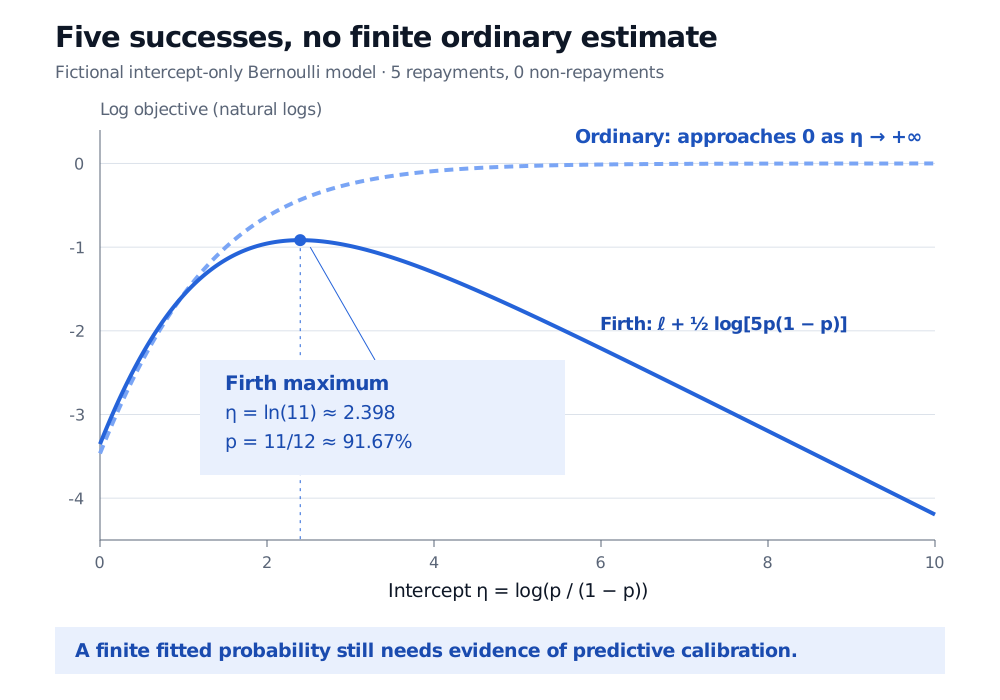
The ordinary log-likelihood is ℓ(η)=5logp. Its derivative is 5(1−p)>0 for every finite η. The probability estimate approaches the boundary p=1 as η→+∞; there is no finite ordinary intercept estimate.
Here I(η)=5p(1−p), so the corrected objective becomes
In a fictional five-repayment cohort, ordinary log likelihood rises toward zero as the intercept tends to infinity. The Firth objective peaks at intercept 2.397895, with fitted repayment probability 11/12, or 91.67 percent.
Original likelihood curves for the fictional intercept-only cohort. The ordinary objective has a supremum at an infinite intercept; the Firth objective has a finite maximum. Vertical values include the displayed penalty constant.
The result looks like adding half a success and half a failure. That shortcut holds for this single-probability model. It is not a rule to add half an observation to every cell in a regression with predictors: the general adjustment depends on the design and fitted leverage, as Firth's §3.3 explains.
Finite does not mean automatically trustworthy
Parameterisation matters. In this example, transforming the Jeffreys prior to a density with respect to p gives the Beta(1/2,1/2) prior. After five successes, the posterior density in p is proportional to p9/2(1−p)−1/2 and diverges at one: it has no interior mode. The Firth probability 11/12 comes from maximising the penalised objective in η and then transforming the estimate. Modes depend on the density's coordinate system, even though Jeffreys' prior measure is invariant.
Bias reduction has a target. Removing the leading bias term for coefficients does not make the transformed probability exactly unbiased or empirically calibrated. A finite repayment estimate from five observations still carries substantial uncertainty. For the separate predictive task, the membership lesson Probability calibration, available through a public preview, explains how held-out outcome frequencies test the probability interpretation.
Estimation is not causal identification. Firth correction changes the estimation objective. It does not establish that a borrower's feature causes repayment, resolve omitted confounding, or make a tiny cohort representative of a future lending population.