A Fenwick tree, also called a binary indexed tree, is an array-backed data structure that maintains prefix sums as individual values change. Adding to one position and summing through any position each take time in the worst case. For a fixed order-book price ladder, it lets a market-data process keep cumulative displayed ask depth current as orders arrive and cancel.
What each slot stores
Number the levels from 1 through in ascending ask-price order. Let be the displayed shares at level . The lowbit of is the value of its rightmost 1 bit, computed as
i & -i. For instance, 6 is binary 110, so its lowbit is 2. Slot tree[6] stores the sum over levels 5 and 6. In general, slot stores the sum over a block of length ending at .To read a prefix, start at its right endpoint. Take that slot's sum, subtract its lowbit from the index and repeat until zero. Each step jumps immediately to the left of the block just counted. To add to a single position, start there and add the change to that slot’s sum. Increase the index by its lowbit and repeat until it passes the last slot. This visits precisely the blocks that contain the changed position. The tree is implicit in these index steps. Zero represents the empty prefix and is never a valid update index. Fenwick’s original paper describes both walks.
A quote update at level 3
Suppose the displayed shares in eight fictional ask levels are . A request for the total through level 7 reads
tree[7], tree[6] and tree[4]. Their blocks cover level 7, levels 5–6 and levels 1–4 respectively, for shares.Now add 2 shares at level 3. The update follows and adds 2 to each of those slots. Only
tree[4] lies on both walks. The same prefix query therefore gives shares.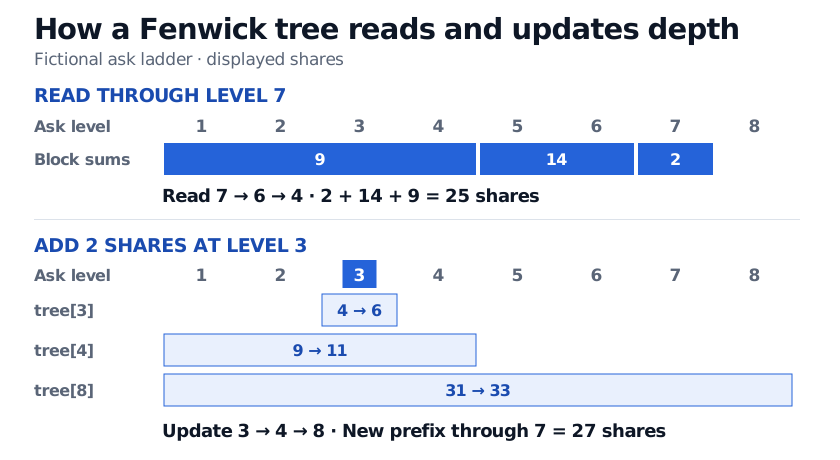
A prefix query reads adjacent blocks that do not overlap. A point update changes the nested blocks that all contain the updated level.
When to use it
With the inclusive prefix through and , the sum from level through is . Each prefix step clears a set bit. Each update step makes the lowbit at least twice as large until the index leaves the array. Both walks thus take at most logarithmically many steps, and the stored totals use space. A static prefix-sum array answers range sums in after construction, but a point change can invalidate every prefix ending at or after that position. For arbitrary interval minima or maxima under point updates, use a segment tree. Laaksonen compares these structures in Chapter 9.
The level-to-index mapping must stay stable while the tree is in use. Order priority at a single price requires order-level information. The SelfMadeQuant Order Books lesson uses cumulative depth to work through a hypothetical fill and explains what queue information matters for passive orders. The preview is public and the full lesson requires membership.
Sources
- Peter M. Fenwick, A New Data Structure for Cumulative Frequency Tables (1994). Principles, cumulative reads and point updates.
- Antti Laaksonen, Competitive Programmer’s Handbook, Chapter 9. One-based implementation, range sums and segment trees.