A deliberate venue delay changes when trading instructions can act. Follow a microsecond timeline, distinguish message paths, and assess execution trade-offs.
Exchange speed bump
An exchange speed bump is a deliberate delay imposed by a trading venue on specified messages before their instructions can take effect. It is a market-design choice: by changing when an order can interact with the order book, the venue can change a race between incoming trading instructions and information used to update prices.
That makes it different from ordinary network latency. A slow connection is an engineering fact. A speed bump is an intentional rule or architecture feature, with defined coverage. For a quant building an execution model, “the venue adds a delay” is incomplete: which messages, on which path, and before which event?
The race that a delay can change
Suppose a quote reflects an earlier market state. A fast trader may observe a price change elsewhere and attempt to trade against that quote before it updates. The resulting stale-price exposure is one form of adverse selection. A venue may insert a delay to give its price-update mechanisms time to incorporate information before an incoming order can execute.
This does not mean that adding the same delay to two competing orders erases their speed difference. Under a strictly fixed traversal and identical subsequent handling, an order entering 50 microseconds ahead exits 50 microseconds ahead. The important comparison may instead be between the delayed order path and a different information or order-management path. Their treatment must be established from the venue's actual design.
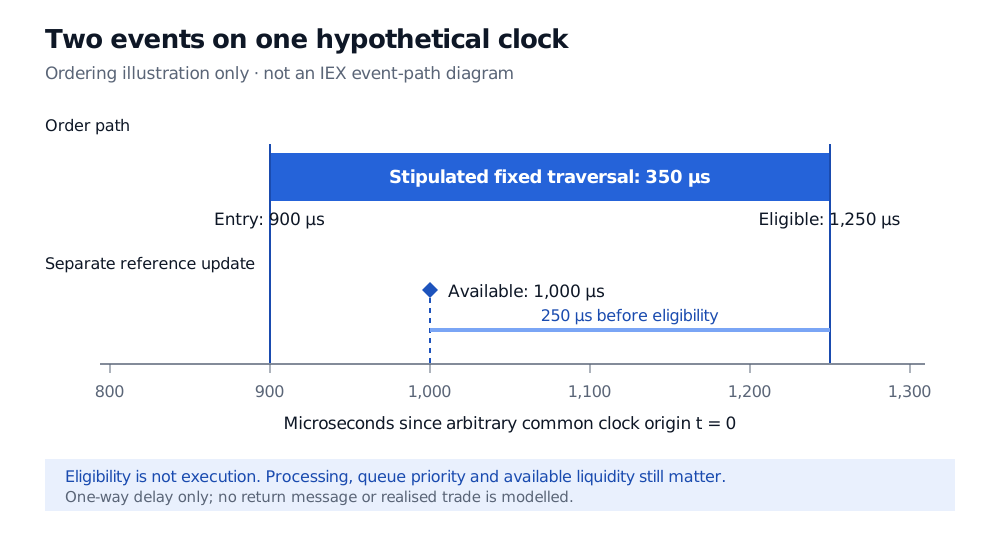
Here is an original hypothetical timeline. All timestamps use one common clock, whose arbitrary origin is t=0; units are microseconds, abbreviated µs. Assume:
an order reaches the delay entry at 900 µs;
that path has a stipulated fixed, one-way traversal of 350 µs;
a separate reference-price update is available at 1,000 µs on the same clock.
The order becomes eligible for subsequent processing at
teligible=900+350=1,250μs.
The reference update precedes eligibility by 1,250−1,000=250μs. Without the stipulated traversal, the order's 900 µs entry would precede that update. The arithmetic illustrates how a delay can change event ordering.
Hypothetical shared clock: order entry at 900 microseconds plus a fixed one-way 350-microsecond traversal gives eligibility at 1,250. A separate reference update at 1,000 precedes eligibility by 250 microseconds. No execution is assumed.
Original hypothetical ordering example, not an IEX architecture diagram. One-way timing uses a shared arbitrary clock origin; processing and execution are outside the calculation.
Eligibility is not a fill. The example stipulates when the reference update is available; it does not establish an actual exchange's bypass path, the order in which its software processes events, or whether a resting order reprices. Matching rules, quantity ahead, hidden interest and available liquidity still govern execution. Nor does the example prove that a delay removes a trader's predictive advantage.
IEX: an inbound delay, with specific boundaries
As checked on 31 October 2026, IEX's technology description specifies a 350-microsecond inbound delay produced by coiled optical fibre together with geographic distribution and network connectivity. It describes incoming orders and messages traversing that path, while market data received from other venues is not subjected to the speed bump. The page reports that its coil increased from 38 to 44 miles following the 2024 data-centre relocation to maintain the inbound delay.
These boundaries matter. IEX's September 2024 SEC filing, §II.A.1, explains that outbound messages had ceased traversing the coil in February 2021; the 2024 change removed the then-specified outbound-latency references as the facilities moved closer together. It also describes an additional inbound delay when IEX's routing logic sends a routable child order to its own book. Thus “350 µs” should not be treated as a universal end-to-end order lifetime, an outbound delay, or a round-trip measurement. The filing describes a dated rule change and migration, rather than a present-day measured latency distribution.
IEX's price-prediction Signal is also a distinct mechanism from the physical speed bump. The technology page describes the delay as providing a buffer for that mechanism. A prediction can still be wrong; delaying an instruction does not make future prices known.
Coverage changes the economics
A speed bump can be fixed or randomised, and broadly applied or selective. An asymmetric design treats relevant message classes or participants differently; its effects cannot be inferred from the delay's duration alone.
For a historical contrast, Anderson and co-authors' 2018 study, “Data and institutional details,” describes TSX Alpha's 2015 design: a randomised one-to-three-millisecond delay with an exemption for qualifying post-only messages. That is evidence about the study's historical design, not a specification of Alpha today. It illustrates why an exemption is part of the mechanism rather than a footnote to a single latency number.
When modelling a venue, distinguish the deliberate traversal from network distance, gateway validation, processing congestion and time spent behind other orders. Establish whether submissions, amendments and cancellation requests are delayed, whether internal repricing is treated differently, and how outbound acknowledgements and market data are delivered. A cancellation request in flight may still race an execution; the request alone does not establish that the order is gone.
For routing, evaluate fees, fill probability, execution size, missed trades and subsequent price moves alongside delay. A liquidity provider may face fewer stale-price executions but also fewer fills. A liquidity taker may find a quote changes before the delayed order can reach it. Neither outcome establishes a guaranteed retail advantage, and no speed bump eliminates adverse selection in general.
The lesson Order Flow and Adverse Selection develops the value of passive fills conditional on execution and explains why nonfills belong in the assessment. It has a public preview; the full lesson requires membership. That distinction between attractive quoted prices and realised execution outcomes is essential when assessing any speed-bump design.
Sources
IEX: Technology — The Speed Bump and The Signal, checked 31 October 2026 — current published description of the inbound path, away-market data and the post-2024 coil change; the Signal is a separate mechanism.
SEC: SR-IEX-2024-17, Release 34-101018, 12 September 2024, §II.A.1, pp. 3–7 — dated explanation of inbound, outbound and routing paths and removal of outbound-latency references during the migration.