Break return on equity into net profit margin, total asset turnover and the equity multiplier, then compare firms with the same headline ROE.
DuPont Decomposition of Return on Equity
The DuPont decomposition expresses a company's return on equity (ROE) as net profit margin × total asset turnover × equity multiplier. An equity analyst can use it to see whether two companies with the same ROE differ in profit per dollar of sales, sales per dollar of assets, or assets per dollar of book equity. CFA Institute, Financial Analysis Techniques
Match the flows and balances
Let N be net income and S be net sales over the same fiscal period. Let Aˉ and Eˉ be average total assets and average book equity over that period. The factors follow the order margin, turnover and multiplier.
ROE=EˉN=SN×AˉS×EˉAˉ.
Net profit margin measures after-tax profit per dollar of sales. Interest expense is already reflected in net income.
Total asset turnover measures sales generated per dollar of average assets over the stated period. A quarterly turnover and an annual turnover cover different amounts of selling time.
Sales and average assets cancel because each appears once in a numerator and once in a denominator. The three-factor form requires nonzero sales, average assets and average equity. Net income and sales accumulate throughout the period, while the balance sheet records snapshots. Averaging opening and closing balances is a common starting point. More frequent balances can better represent the capital in use if the company is seasonal or made a large acquisition during the period. Use the same asset average in both factors, and match net income to the equity claim. For common ROE, use earnings available to common shareholders and common book equity. CFA Institute, worked DuPont analysis · Nissim and Penman, §2.1
The same 20% ROE
Take two fictional companies over one fiscal year. All amounts are in USD millions, each has only common equity, and averages use the opening and closing balances.
Input
Company A
Company B
Net income
20
24
Net sales
200
300
Opening → closing total assets
360 → 440
220 → 260
Opening → closing book equity
90 → 110
110 → 130
Average total assets
400
240
Average book equity
100
120
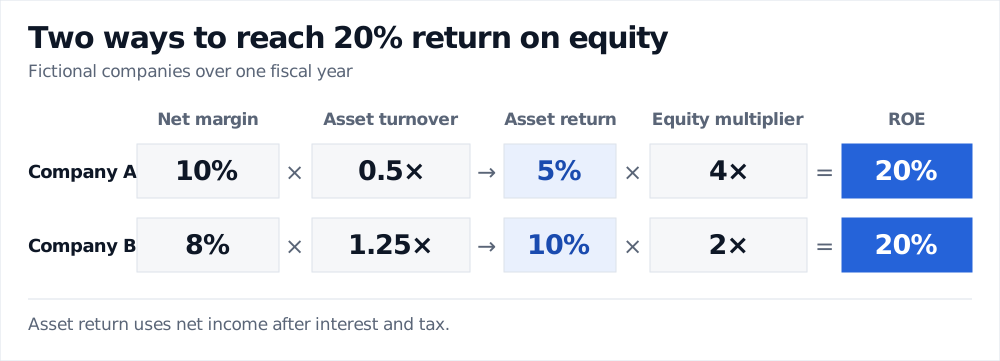
Company A earns 20/100=20% on its average equity. Company B earns 24/120=20%. The figure groups the first two factors so you can compare how much net income each firm earns per dollar of assets before applying the equity multiplier.
Company A has a 10% margin, 0.5× turnover, a 5% asset return and a 4× equity multiplier. Company B has an 8% margin, 1.25× turnover, a 10% asset return and a 2× equity multiplier. Both have 20% ROE.
The first two factors combine into net income per dollar of average assets. The equity multiplier then expresses that result per dollar of average book equity.
Company B earns less on each dollar of sales but generates more sales from each dollar of assets. On an after-interest, after-tax basis, B earns twice as much per dollar of assets as A. A reaches the same ROE with twice as many assets per dollar of book equity.
Follow the change back to the statements
The decomposition is an accounting identity. It tells you which ratios changed and where to investigate. Even an exact allocation of the change in ROE needs a convention. If you swap in the new factor values one at a time, the amount assigned to margin depends on whether you use the old or new turnover and equity multiplier. And if average assets rise while sales and equity stay fixed, the multiplier rises by the same factor that divides turnover. The two changes cancel. CFA Institute, Financial Analysis Techniques
If the multiplier rises, look at liabilities and equity separately. A share buyback can shrink book equity and lift reported ROE at unchanged positive profit. Aswath Damodaran, Return Measures
Additional borrowing may raise interest expense and reduce net margin, so the reported multiplier alone gives no estimate of what more borrowing would do to future ROE. Nissim and Penman, §2.1
Near-zero average equity can produce an extreme ratio. With zero average equity it is undefined, and with negative equity even a loss can produce a positive ROE. Damodaran, Return Measures
If ROE feeds a stock screen, compare firms with similar business models and check extreme values against book equity and financing. The SelfMadeQuant lesson on cross-sectional alpha signals uses ROE as a quality characteristic and shows how to rank signals and adjust for sector effects. The preview is public. The full lesson requires membership.