Comprehensive Capital Analysis and Review (CCAR) is the Federal Reserve's framework for assessing large banking firms' capital adequacy and the processes they use to plan their capital needs. Its practical purpose is to connect projected losses in a severe downturn with a bank's ability to keep operating and lending. A quant working on CCAR needs more than a loss model: the loss projections must feed a coherent capital plan. The Fed's 2019 instructions describe the original combination of quantitative capital assessment and qualitative review of capital planning.
The name needs a date attached. The Fed now groups its CCAR exercises as historical material for 2011–2021; supervisory stress testing, capital planning and stress capital buffers continue, with important changes to the original objection process.
CCAR, DFAST and the capital buffer
Stress testing asks what would happen under specified adverse conditions. DFAST, the Dodd-Frank Act stress-testing framework, supplies statutory supervisory and company-run tests. Historically, those tests informed CCAR's broader review of a firm's capital plan, including planned distributions and its governance. They were related processes, rather than interchangeable names for one calculation. Federal Reserve, 2019 instructions, Introduction and Overview.
Two changes are essential when reading older CCAR reports:
- 2019: qualitative objections were removed for most firms, with transition exceptions for newer participants. Scrutiny of capital-planning quality continued through supervision; removing an objection mechanism did not remove expectations for sound planning. Federal Reserve, 6 March 2019.
- 2020: the stress capital buffer (SCB) replaced the quantitative objection process. Supervisory stress results and planned dividends feed firm-specific risk-based capital buffer requirements. Distribution restrictions operate through the capital rule, rather than the old quantitative objection decision. Capital plans remain planning tools. Federal Reserve, Q&A GEN0216.
Consequently, an old headline saying a bank “passed CCAR” does not describe the full modern capital framework.
From losses to a capital ratio
Consider a fictional capital bridge, in USD billions. Beginning common equity tier 1 (CET1) capital is 12 and risk-weighted assets are fixed at 100. Assume stress losses of 6, offsetting pre-provision net income of 2, and no taxes, distributions, regulatory adjustments or other changes:
The CET1 ratio falls from to : a 4 percentage point decline. Offsetting income matters because gross losses alone do not determine capital depletion.
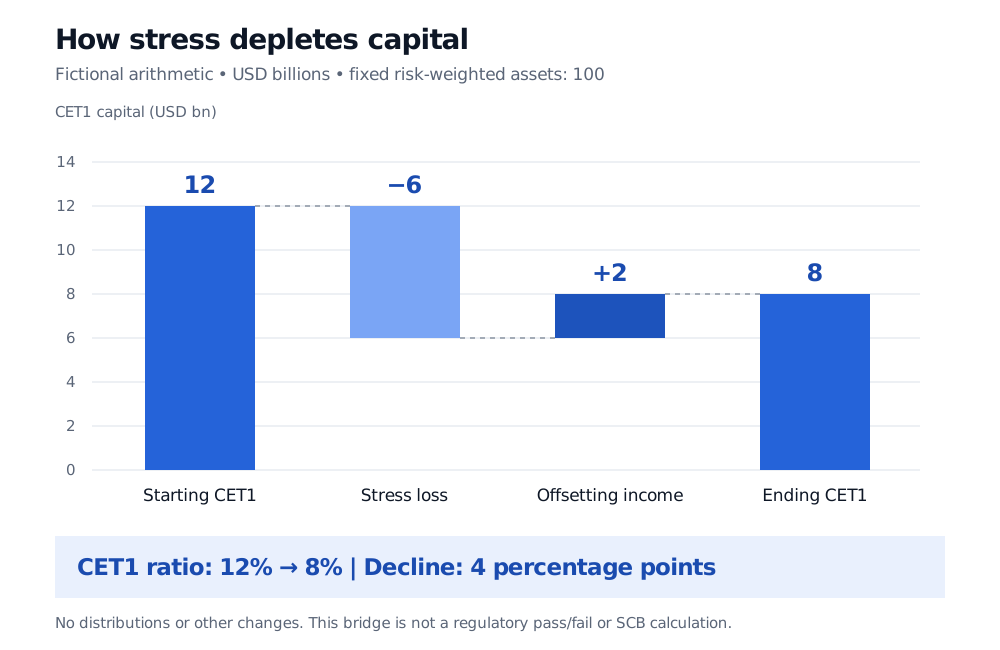
This is neither a pass/fail result nor an SCB calculation. An actual stress test projects a path; its lowest capital ratio need not occur at the endpoint. Risk-weighted assets can change, and other capital measures, regulatory adjustments and distribution assumptions matter. The Fed's 2026 stress-test announcement describes projections of losses, net revenue and capital under hypothetical scenarios. Those scenarios are not economic forecasts.
Read the rule's effective date
Status checked 30 October 2026. The Fed voted in February 2026 to maintain existing SCBs until new requirements could be calculated in 2027. Two final rules published on 2 October had been adopted but were not yet effective on this article's check date:
- The SCB calculation rule, FR Doc. 2026-20246, takes effect on 1 December 2026. It moves annual SCB effectiveness to January 1; the first new requirements under that timetable take effect on 1 January 2028. Equal averaging of the stress capital declines from two consecutive annual tests begins with requirements effective 1 January 2029, using 2027 and 2028 results for affected firms. The dividend add-on is not averaged.
- The transparency rule, FR Doc. 2026-20247, takes effect on 2 November 2026. It establishes enhanced model disclosure and public-input processes for material model changes and annual scenarios.
A final rule's legal effective date and the first capital requirement calculated under a particular provision can therefore differ.
For the underlying distinction between regulatory, economic and book capital, see Mapping Risks: The Loss Operator and Risk Factor Representation on SelfMadeQuant.com. A public preview is available; the full lesson requires membership.
Sources
- Federal Reserve: CCAR 2019 Summary Instructions, Introduction and Overview of CCAR Process — historical scope and DFAST relationship.
- Federal Reserve: CCAR Historical Exercises, 2011–2021.
- Federal Reserve: limiting the qualitative objection, 6 March 2019.
- Federal Reserve: CCAR and DFAST Questions and Answers, GEN0216, response dated 23 March 2020 — quantitative objection replacement and ongoing planning.
- Federal Reserve: 2026 scenarios and maintenance of current SCBs, 4 February 2026.
- Federal Register: Modifications to the Capital Plan Rule and Stress Capital Buffer Requirement, 91 FR 62636, 2 October 2026, Dates; I.A.4; I.B.1–2; I.C.
- Federal Register: Enhanced Transparency and Public Accountability of the Supervisory Stress Test Models and Scenarios, 91 FR 62870, 2 October 2026, Dates; I.G; II.