Communications recordkeeping captures and preserves covered business communications so they can be retrieved. Communications surveillance reviews communications for signs of policy breaches or possible market abuse. For a surveillance quant, linking a chat to an order can put a trading decision in context. The result depends on which messages the archive captured and whether the identities and timestamps line up.
Preserving a message and reviewing it
An archive can hold email, chats, texts and applicable call recordings. It preserves the original material and the context needed to find it, such as participants, timestamps, thread identifiers and attachments. A surveillance system can use keyword rules or language models to flag messages for review. It can also look for orders in the same account and instrument within a specified time window. A flag should lead back to the full thread or original recording so the reviewer can check how a phrase was used or whether the transcript got it right. A quiet alert queue may reflect a gap in capture, especially when employees move business conversations to an unapproved app. FINRA’s 2026 oversight findings on books and records.
For covered U.S. broker-dealers, SEC Exchange Act Rule 17a-4(b)(4) requires preservation of received and sent communications relating to the firm’s broker-dealer business, including internal communications and any approvals. A business message can fall within scope even when sent on a personal app. Paragraph (f) allows electronic preservation using either a complete time-stamped audit trail that permits recreation of the original record or storage that prevents rewriting and erasure. The system must also be able to locate and produce records. SEC Exchange Act Rule 17a-4.
FINRA Rule 3110(b)(4) requires member firms to establish procedures for reviewing written correspondence and internal communications related to their investment banking or securities business. Its supplementary material sets out where additional review is risk-based and what evidence the firm keeps of the review, including who reviewed which communication, when, and what action followed any significant regulatory issue. FINRA Rule 3110(b)(4) and .06–.09.
A chat and an order 90 seconds apart
In a fictional case, a desk chat asks, “Can we buy ExampleCo for Orchard before the announcement?” The chat platform records the send time as 1 January 2026 at 19:00:00 with a UTC−05:00 offset. That converts to 2 January at 00:00:00 UTC. The account directory in effect at the time maps Orchard to A-17. The order system records a buy order for ExampleCo on A-17 at 00:01:30 UTC on 2 January, 90 seconds later.
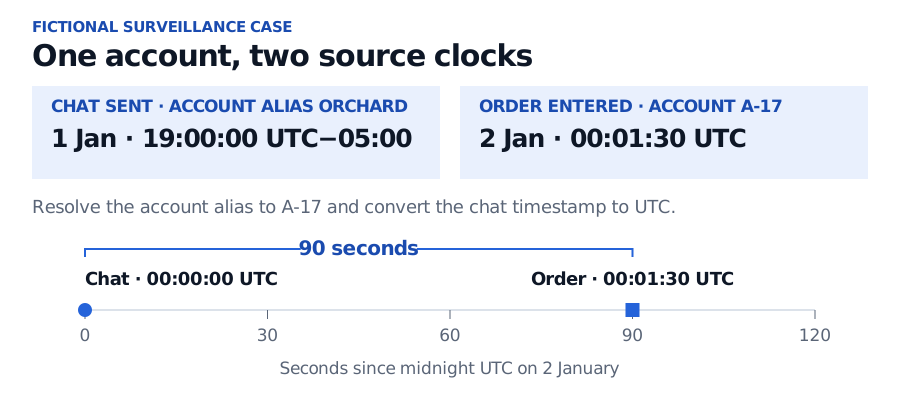
The account directory supplies the identity match. The source timestamps supply the elapsed time after conversion to UTC.
Use message send and order entry times for this comparison. Archive ingestion, order receipt at a venue and execution each record different events. Converting to UTC handles the offset. It leaves any clock skew between the systems in place. If uncertainty in the source clocks is large enough to erase or reverse the apparent sequence, the event order is unresolved. Where fills exist, follow the order identifiers to the trade blotter. An entered order may have been cancelled or left unfilled.
The match gives a reviewer a reason to inspect the conversation and order history together. The full thread might point to a publicly scheduled release and a previously approved hedge. The order history can show when that instruction was created or changed. Timing and account identity alone leave open whether the message prompted the order or whether anyone used confidential information.
The SelfMadeQuant lesson Observation, Event and Availability Timestamps works through event time, receipt time and clock uncertainty. The preview is public and the full lesson requires membership.
Sources
- SEC Exchange Act Rule 17a-4, 17 CFR § 240.17a-4, paragraphs (b)(4) and (f).
- FINRA Rule 3110, Supervision, paragraph (b)(4) and Supplementary Material .06–.09.
- FINRA 2026 Annual Regulatory Oversight Report, Books and Records, pp. 34–36, published December 2025.