Commodity trade finance covers the funding and payment arrangements behind a physical commodity sale. A documentary letter of credit (LC) is a bank’s undertaking to pay a seller against a complying presentation of the documents specified in the credit. A grain exporter can have a bank commitment in hand and still need cash to buy, prepare and ship the grain. For a cash-flow forecast, the payment undertaking determines who owes the money and under what conditions. Working-capital finance covers the bills that come due before the money arrives. U.S. International Trade Administration, Trade Finance Guide
Who has promised to pay?
The importer is the applicant and the exporter is the beneficiary. The rules below apply where the credit expressly incorporates the International Chamber of Commerce’s Uniform Customs and Practice for Documentary Credits (UCP 600), subject to any express modifications or exclusions in the credit. Under those rules the credit is irrevocable, and the issuing bank is bound from issuance. ICC UCP 600, Articles 1–3 and 7
| Bank role | What the exporter can rely on |
|---|---|
| Issuing bank | Issues the credit, typically at the importer’s request, and undertakes to honour a complying presentation under the credit’s terms. |
| Advising bank | Relays the credit and checks its apparent authenticity. Advising by itself carries no undertaking to pay. |
| Confirming bank | With the issuer’s authorisation or request, adds its own undertaking to honour or negotiate a complying presentation under the applicable terms. The same bank can advise and confirm. |
On a confirmed sight credit available with the confirming bank, it pays a complying presentation made to it under its own undertaking. The exporter can therefore have a second bank commitment against issuer credit risk. The documentary conditions still apply. ICC UCP 600, Articles 2 and 7–9
A USD 100,000 wheat invoice
A fictional exporter sells 250 tonnes of wheat at USD 400 per tonne. The importer arranges an irrevocable UCP 600 credit for the full USD 100,000, available by sight payment with the issuing bank. The credit calls for a commercial invoice, an on-board bill of lading and an inspection certificate.
The exporter spends USD 72,000 on the wheat and preparation on day 0, ships on day 6 and presents the documents to the issuing bank on day 8, within the time allowed. Assume the issuing bank finds the presentation complying and pays in full on day 10. Ignore fees, interest and all other cash flows. The exporter receives USD 100,000, with cumulative cash flow on the trade rising from negative USD 72,000 to positive USD 28,000.
At sight means payment against a complying presentation without a deferred maturity. The issuing bank still has up to five banking days after the day of presentation to decide whether the documents comply. The test draws on the terms of the credit, applicable UCP 600 provisions and international standard banking practice. That is an examination window. The example’s day 10 is an assumed receipt date measured in calendar days. ICC UCP 600, Articles 2, 6, 14 and 15
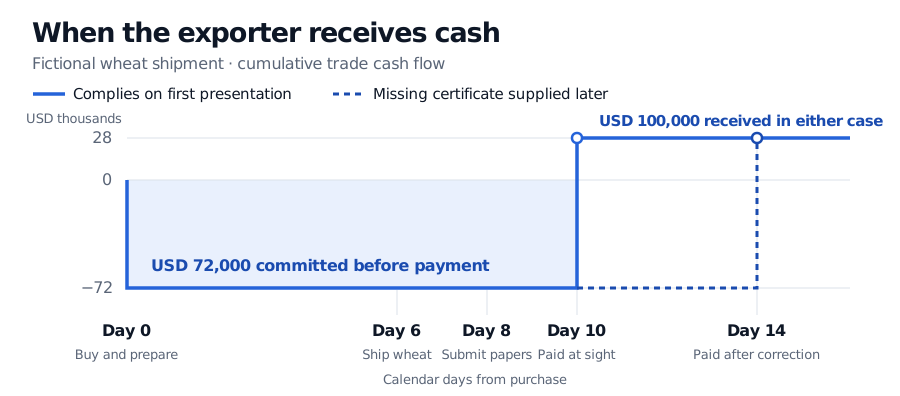
The missing certificate extends the time the exporter has USD 72,000 tied up by four calendar days.
Two things that can go wrong
- The certificate is missing. The issuing bank may refuse the day-8 presentation even though the wheat shipped. Suppose the exporter supplies the certificate in time, the new presentation complies and the bank pays on day 14. The receipt stays at USD 100,000 in this scenario. The exporter has to cover the same USD 72,000 for four more days, which is a funding liquidity risk if its cash or borrowing runs out first. ICC UCP 600, Articles 14 and 16
- The wheat is damaged in transit. In a separate scenario, assume the presentation still complies and the issuing bank pays the same USD 100,000. The credit is separate from the sale contract, and the bank examines the stipulated documents. Who bears the loss depends on the sale terms. Any recovery from the carrier or a cargo insurer depends on the carriage contract or policy and applicable law. ICC UCP 600, Articles 4–5, 14 and 34, ICC, Incoterms 2020 introduction, sections V–VI
A working-capital loan or credit line can fund the USD 72,000 before payment. With a deferred-payment credit, the bank takes on an obligation to pay at the specified maturity when it receives a complying presentation. A nominated bank may separately agree to advance cash against a deferred payment undertaking it has incurred. For the exporter’s forecast, record any financing draw on the day it becomes usable, the sale proceeds on the expected settlement date and the financing repayment when it falls due. ICC UCP 600, Articles 2, 7(c) and 12(b), U.S. International Trade Administration, Export Working Capital Financing