Two tasks, one parameter
Consider a deliberately restrictive synthetic model: its only prediction is one scalar . Task A wants the prediction ; task B wants . Their losses are
Training A to its optimum gives . Training B alone to its optimum then moves the same parameter to .
| Model snapshot | Shared parameter | Loss on A | Loss on B |
|---|---|---|---|
| After training A | 1 | 0 | 4 |
| After training B | −1 | 4 | 0 |
The new task has been learned perfectly, yet the old loss has risen from zero to four. No old observation has been deleted; the model's parameter has changed.
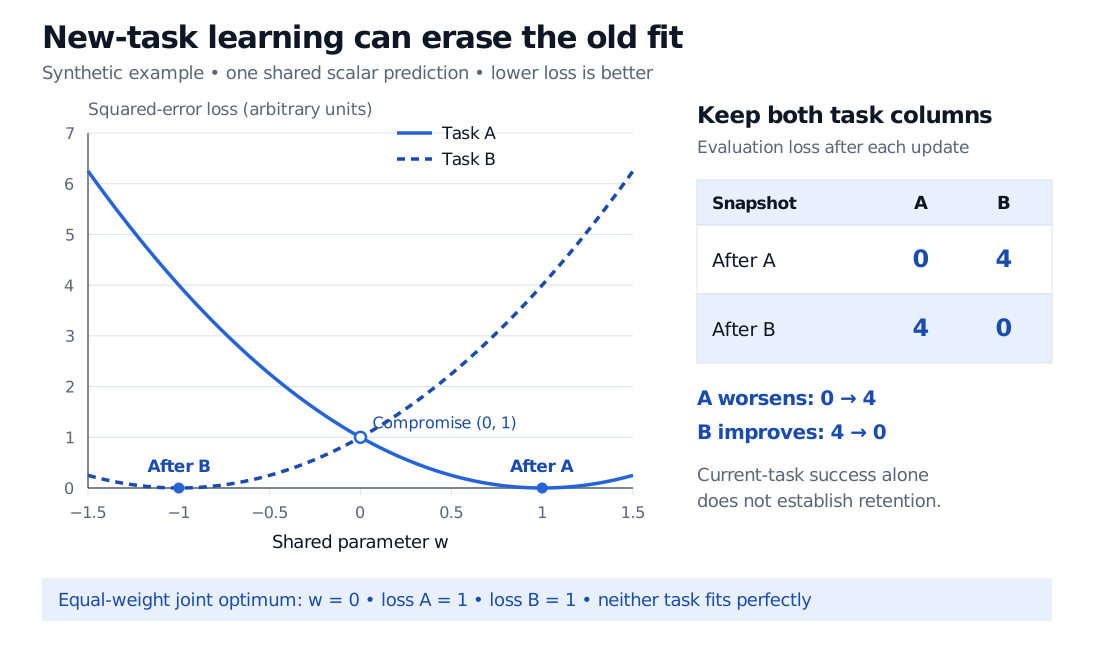
If both tasks matter equally, minimising their mean loss gives , with loss one on each. This is a compromise, not perfect retention plus perfect adaptation. The scalar cannot satisfy two incompatible targets simultaneously. A richer model with an observable task input could represent different answers; a real network may also have compatible solutions unavailable in this toy example.
Measure the old task after the update
Retention compares an earlier task's performance before and after later training. Adaptation measures learning on the new task. Backward transfer can be beneficial: new learning may improve old tasks. State the metric's direction; higher accuracy is better, whereas higher loss is worse. An average across tasks can hide a collapse in one column, and small evaluation samples can make apparent changes noisy.
For financial data, define the required capabilities before scoring retention. For example, a hypothetical execution model might need to handle both liquid and thin books after an update concentrated on liquid trading. Evaluate each slice using fixed, separate held-out observations and consistent costs and targets. Training replay data must remain separate from evaluation data. Save model snapshots and keep the evaluation protocol chronological: future observations or labels cannot guide an earlier update.
This separates forgetting from concept drift. Drift changes the data-generating relationship; forgetting changes the model's performance on an earlier, fixed evaluation problem. A frozen model can deteriorate in a changing market without forgetting anything. Conversely, an updated model can forget an old task even when that task's evaluation distribution is unchanged.
If an obsolete pricing relationship should cease to influence predictions, downweighting it can be desirable adaptation. If a previously learned stress response remains part of the model's intended remit, losing it is a retention failure. Decide which historical behaviours should survive; maximising retention of every past regime is not automatically the right financial objective.
The available levers have different costs
| Approach | What it preserves | What must be checked |
|---|---|---|
| Replay or rehearsal | Exposure to stored examples from earlier tasks alongside new data | Memory and training cost; whether the retained sample covers important old behaviour; whether obsolete examples obstruct adaptation |
| Regularisation | Parameters or outputs judged important to earlier tasks | Whether the importance estimate is informative; whether protection leaves enough freedom to learn the new task |
| Architectural separation | Earlier computations through frozen or separate task components | Capacity growth, shared preprocessing and how the correct component is selected at prediction time |
Sources
- Kirkpatrick et al. (2017), Overcoming catastrophic forgetting in neural networks, introduction and Results: EWC.
- Lopez-Paz and Ranzato (2017), Gradient Episodic Memory for Continual Learning, Sections 2–3.
- Rusu et al. (2016; arXiv revision 2022), Progressive Neural Networks, Section 2, including Limitations.
- Van de Ven and Tolias (2019), Three scenarios for continual learning, Sections 2–3.