A capacity market procures commitments from resources to be available in a future delivery period so the system has enough supply or demand response when it needs it. Ancillary services are products that help the operator keep the grid stable in operation, including frequency regulation and operating reserves. For an asset valuation, these sit alongside electricity sales. A capacity commitment, a reserve assignment and a sale of delivered energy each have their own quantity and payment rules. PJM Manual 18 and FERC’s ancillary-services overview describe the two reliability roles.
Which megawatts earn the capacity payment?
Nameplate MW describes a unit’s rated power. Accredited MW is the quantity the market recognises as contributing to resource adequacy under its rules. Cleared MW is the quantity accepted for a commitment through the auction. In PJM’s Reliability Pricing Model, for example, Effective Load Carrying Capability analysis helps determine accredited unforced capacity for eligible resources by assessing how their availability and output line up with system reliability needs. A cleared capacity performance commitment can also face a non-performance assessment in the delivery year. PJM Manual 18, §§1.5 and 2.1.5.
Suppose a fictional generator has 100 MW accredited and fully cleared for 30 days at a stipulated USD 25 per MW-day. With a constant award and rate, its gross capacity payment is
The MW and days cancel, leaving dollars. The calculation has no energy-production input. If the generator delivered 100 MW steadily for one hour, that would separately be 100 MWh of energy. The fictional payment leaves out costs, penalties and settlement adjustments. An actual capacity ledger needs the market’s cleared quantity, applicable rate and delivery-period rules.
What the operator needs now
- Frequency regulation follows a control signal up or down to correct small, ongoing imbalances. In PJM, regulation credits reflect performance-adjusted MW, so how closely the resource follows the signal matters to revenue. PJM Manual 11, §§3.2.2 and 3.10.
- Operating reserves provide a short-notice response to events such as the loss of a generator. An upward reserve award holds MW ready for use, with a response obligation if called. PJM’s synchronized reserve product pays resources to stand ready. During an event, PJM checks the size and duration of the response. A shortfall can trigger a charge and repayment of earlier reserve credits. FERC’s product overview and PJM Manual 11, §4.5.
Consider an online generator with a 100 MW operating ceiling. Scheduling the full 100 MW leaves no room to increase output. An award of 30 MW of upward reserve caps its scheduled output at 70 MW in this simplified example. The resource must also be able to ramp up fast enough and sustain the extra output. That shared constraint creates an opportunity cost if holding reserve displaces a profitable energy sale. PJM accounts for that trade-off by clearing energy and operating reserves jointly in its day-ahead and real-time markets. PJM Manual 11, §4.4.
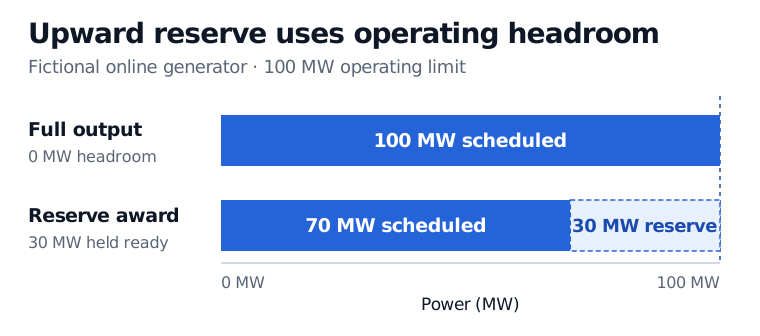
An upward reserve commitment can use the same operating headroom as scheduled output. The example assumes the generator can deliver the required response.
The SelfMadeQuant battery project applies the energy-versus-reserves trade-off to an ERCOT battery, tracking dispatch decisions and separate energy and ancillary-service revenues. The preview and figures are public. The full project requires paid membership. Grid Battery Valuation, Dispatch and Hedging.
Sources
- FERC — Ancillary Services. Product categories and short-notice performance obligations.
- PJM Manual 18 — PJM Capacity Market, revision 63, effective 24 September 2026. Resource adequacy, accreditation and capacity performance.
- PJM Manual 11 — Energy & Ancillary Services Market Operations, revision 137, effective 28 July 2026. Regulation credit, reserve clearing and event performance.