Identify the historical BJZZ fractional-penny retail-flow proxy, apply its strict boundaries, and separate estimated direction from investor identity and sample coverage.
Boehmer–Jones–Zhang–Zhang retail classification
Boehmer–Jones–Zhang–Zhang retail classification (BJZZ) estimates marketable retail purchases and sales from fractional-penny prices in U.S. off-exchange transaction data. It lets a researcher construct a retail-flow proxy when investor identities are unavailable. The 2021 method starts with TAQ exchange code D. Its motivation is small retail price improvements: sales just above a penny and purchases just below one. Boehmer, Jones, Zhang and Zhang, §I.
Which part of the penny?
For an eligible transaction price P in dollars per share, define
z=100mod(P,0.01),0≤z<1.
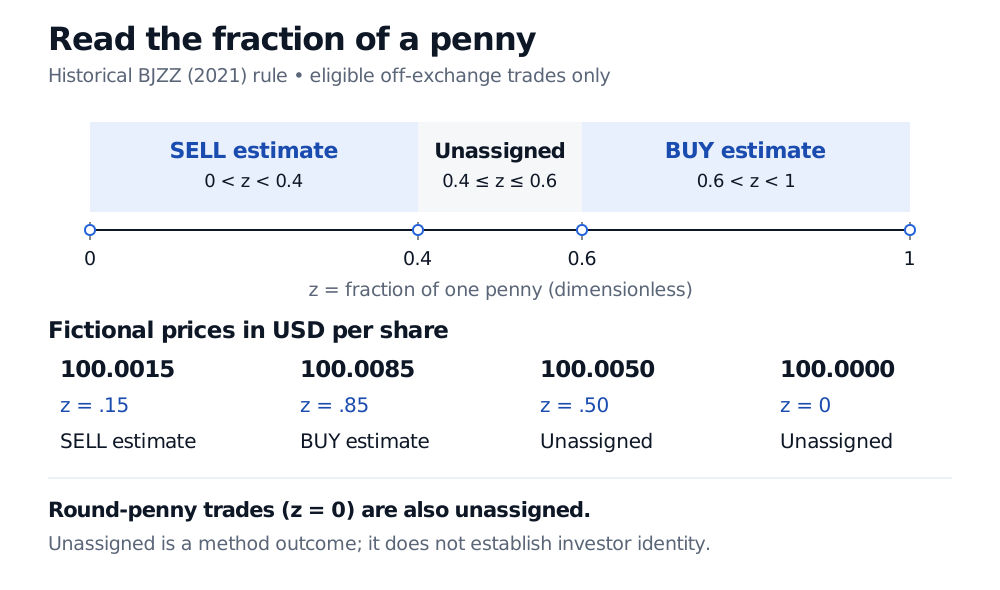
The original rule is strictly0<z<0.4 for a retail-sell estimate and 0.6<z<1 for a retail-buy estimate. Round pennies and the whole interval 0.4≤z≤0.6 remain unassigned. The central exclusion avoids midpoint executions associated with institutional trading. BJZZ, §I.B.
Consider four fictional eligible trades. Prices are USD per share; the rule is applied independently to each row.
Price P
Remainder above the lower penny
Fraction z
Historical method label
100.0015
0.0015 dollars
0.15
Retail-sell estimate
100.0085
0.0085 dollars
0.85
Retail-buy estimate
100.0050
0.0050 dollars
0.50
Unassigned
100.0000
0 dollars
0
Unassigned
For intuition, suppose the first trade improves a bid of 100.00 by 0.0015 dollars. The second improves an ask of 100.01 by the same amount. Their locations within the penny differ because improvement raises the seller's receipt and lowers the buyer's payment. These quotes are illustrative assumptions, not additional inputs to the fractional-price formula.
Historical BJZZ intervals: fractions strictly between zero and 0.4 are retail-sell estimates; strictly between 0.6 and one are retail-buy estimates; zero and 0.4 through 0.6 are unassigned. Fictional prices 100.0015, 100.0085, 100.0050 and 100.0000 yield fractions 0.15, 0.85, 0.50 and zero.
Original historical-rule diagram and fictional USD-per-share examples. Open boundaries matter: 100.0040 and 100.0060 are both unassigned.
Preserve decimal price precision. Computing a remainder with binary floating-point values can move an exact boundary across a strict inequality. Decimal strings or integer price units fine enough to preserve the source feed's precision make the convention reproducible; rounding every price to cents first destroys the identifying information.
What your flow series measures
Suppose the identified purchases total 600 shares and identified sales total 400 shares in a fictional interval. Their order-flow imbalance is
600+400600−400=0.20.
If eligible transactions total 3,000 shares, the identified share is separately 1,000/3,000=1/3. The imbalance denominator contains classified flow; the coverage denominator contains all eligible flow. Report both. A positive imbalance with low coverage need not describe the omitted transactions.
“Unassigned” does not mean institutional, and an assigned label does not establish a person's identity. Every transaction still has a buyer and a seller. Keep this sampling rule separate from a general trade-sign estimator such as Lee–Ready: assigning signs to other trades does not make those trades retail.
A dated estimator needs dated validation
The paper studies 2010–2015 common stocks, CRSP share codes 10 or 11, on NYSE, NYSE MKT and NASDAQ, with a previous-month-end price screen of at least one dollar. Its direction check uses 117 stocks on the NASDAQ TRF in October 2010. This limited check does not establish universal investor-identification accuracy. The proxy omits retail activity without qualifying fractional prices. BJZZ, §I.A and §I.D.
The regulatory backdrop also needs a date. Checked 31 October 2026: the SEC's June 11, 2026 order extends relief from the amended minimum pricing increment and access-fee-cap requirements until the first business day of November 2027. The adopted half-cent increment for certain stocks is therefore not a basis for assuming that reform already governs this example. Quotation/order increments and permitted execution prices are distinct matters. SEC Release 34-105656, introduction and relief order.
For a new dataset, document its venue-code mapping, reporting precision, corrections, security filters, dates and price-improvement regime. Check label disagreement against suitable independently identified orders where available, and inspect coverage by price and market state. An unchanged formula can produce a changed population when routing or execution practices change. Calling every subpenny transaction retail would discard the method's exclusions and its institutional premise.
For the broader measurement discipline, Order Flow and Adverse Selection develops signed-volume features and explains why estimated flow does not establish identity or causal price impact. The link opens a public preview; the full lesson requires membership.